Wooden Play Kitchen Toys: Benefits, Types & OEM Manufacturer Guide
By DreamGo Toys | 20+ Years Wooden Toy Manufacturer in China
Walk into any playroom, daycare, or family home with young kids, and you'll likely spot a wooden play kitchen tucked in a corner. For generations, these miniature cooking spaces have held a special spot in childhood play — and for good reason. Unlike flashy plastic toys that quickly lose their charm, a well-made wooden kitchen grows with your child, sparks hours of creative play, and fits seamlessly into almost any home aesthetic.
If you're researching wooden kitchens for your own child, or exploring options for your retail or brand lineup, this guide breaks down everything you need to know: the most common styles, the real developmental benefits, how to match one to your child's age, and what custom and OEM options look like on the market.
At DreamGo Toys, we have been manufacturing wooden play kitchens for over 20 years. This guide is based on our real manufacturing experience.
[Insert image: Wooden-Kitchen-Toys-DreamGo-Toys.jpg]
Caption: Wooden play kitchen from DreamGo Toys, made from FSC-certified wood.
The Most Common Types of Wooden Play Kitchens
Not all wooden play kitchens are built the same. The right style depends on your available space, your child's interests, and how you plan to use it. Here are the most popular types you'll find today.
1. Freestanding Full-Size Wooden Kitchens
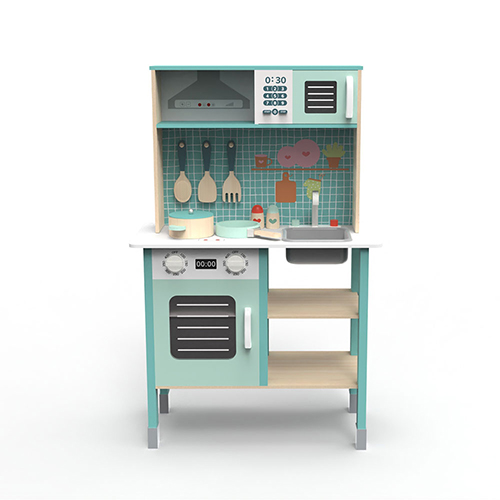
This is the classic style most people picture when they think of a play kitchen. Freestanding models typically stand waist-high for young kids and include all the features of a real kitchen: a stovetop with turnable knobs, an oven with a door, a sink, cabinets, and often a mini refrigerator. Many come with small accessory sets like play pots, utensils, and wooden food pieces.
Full-size kitchens work best in dedicated play spaces or larger bedrooms. Because they're sturdy and have plenty of storage for accessories, they're a great long-term pick for families with multiple kids.
2. Compact & Corner Wooden Kitchens
For smaller homes, apartments, or playrooms with limited floor space, compact and corner-shaped wooden kitchens are a practical alternative. Corner models fit neatly into a right-angle corner, taking up far less room while still offering most of the same core features — a sink, stovetop, and storage shelves.
Compact versions are also easier to move around if you like to rearrange play spaces, and they work well for families who want a play kitchen but don't want it to dominate the room.
3. Outdoor Wooden Play Kitchens
Made from weather-resistant, treated wood (usually pine or cedar), outdoor play kitchens are built to sit in backyards, patios, or playgrounds. They often include extra features like sand and water tables, mud kitchen accessories, and open shelves for nature play.
Outdoor wooden kitchens encourage kids to play outside more, and they pair perfectly with gardening, sensory play, and messy outdoor activities. Just be sure to choose a model made for exterior use, as indoor wooden kitchens will warp or rot if left outside long-term.
4. Themed & Open-Plan Wooden Kitchens
For kids who love immersive role play, themed wooden kitchens add an extra layer of fun. You'll find options styled like retro diners, farmhouses, modern cafes, or even bakery shops with built-in display shelves.
Open-plan or double-sided wooden kitchens are another popular variation. Accessible from both sides, they're ideal for playdates, daycares, or classrooms where multiple kids want to play together at the same time without crowding each other.
Key Benefits of Wooden Play Kitchens for Child Development
A wooden play kitchen is more than just a toy. It's a hands-on learning tool that supports growth across multiple areas of development. Here's how kids benefit from regular pretend play in a wooden kitchen.
1. Boosts Imaginative and Narrative Thinking
Pretend cooking is one of the most open-ended forms of play. A child might pretend to bake cookies for a teddy bear tea party, run a restaurant for their siblings, or copy the meals they see parents make at home. This kind of role play helps them build storytelling skills, practice logical sequencing, and make sense of the world around them.
Unlike screen-based toys that follow a set script, a wooden kitchen has no right or wrong way to play — so creativity can run free.
2. Builds Fine Motor Skills and Hand-Eye Coordination
Turning stove knobs, opening and closing cabinet doors, hanging tiny utensils on hooks, and stacking wooden play food all require precise hand movements. Over time, these small actions strengthen fine motor control and hand-eye coordination, which lay the groundwork for writing, dressing independently, and other daily skills later on.
Even simple tasks like "stirring" a pot or arranging plates on a shelf help kids practice control and spatial awareness.
3. Supports Social and Emotional Learning
When kids play kitchen together, they naturally practice sharing, taking turns, and communicating their ideas. One child might be the chef, another the customer, and they'll negotiate roles, follow made-up rules, and work through small disagreements in the process.
This kind of unstructured social play helps kids develop empathy, practice self-regulation, and learn how to collaborate with others — all critical life skills.
4. Offers Long-Term Durability and Value
High-quality wooden play kitchens are built to last. Solid wood construction can handle years of rough play, dropped accessories, and moving from room to room without breaking. Many families keep a wooden kitchen through multiple children, and some even pass it down to the next generation.
Compared to plastic play kitchens that crack, fade, or stop working after a year or two, a wooden model is often the more cost-effective choice long-term.
5. Promotes Sustainability and Safe Play
For parents concerned about plastic waste and toy safety, wooden play kitchens are a reassuring option. Most reputable brands use sustainably sourced wood, non-toxic water-based paints, and smooth, rounded edges with no small choking hazards for younger kids.
Wood also has a warm, natural texture that feels calming to touch, unlike harsh, shiny plastic. For many families, that natural look is a big bonus — it blends in with home decor instead of sticking out like an eyesore.
Age Guide: Choosing a Wooden Kitchen That Fits Your Child
Wooden play kitchens aren't one-size-fits-all. The best model for your child depends on their age, motor skills, and current play style.
12–24 Months: Simple, Sensory-Focused Models
For toddlers under two, look for a low, sturdy wooden kitchen with large, easy-to-grasp parts and no small accessories. At this age, kids mostly enjoy opening and closing doors, putting large blocks or soft play food in and out, and exploring the texture of the wood.
Safety is the top priority here: rounded corners, stable bases, and non-toxic finishes are non-negotiable. Avoid models with tiny utensils or small food pieces that could pose a choking risk.
2–4 Years: Feature-Rich Role-Play Kitchens
This is the prime age for play kitchen fun. Kids between two and four love imitating adult behavior, so a kitchen with realistic details — turnable knobs that click, an oven door that opens, a removable sink — will get hours of use.
At this stage, kids also start engaging in more complex pretend play, so accessories like play pots, wooden food sets, and little dishes add a lot of value. Look for a kitchen height that lets your child stand comfortably without hunching or reaching too high.
5–8 Years: Larger, More Detailed Kitchens
Older preschoolers and early elementary kids still enjoy play kitchens, but they need more space and more complex features to stay engaged. Larger models with extra storage, multiple workstations, or themed add-ons (like a cash register for a restaurant setup) work well for this age group.
Many kids this age also enjoy playing with friends, so an open-plan or double-sided kitchen can be a great investment for playdates.
[Insert image: Wooden-Play-Kitchen-Toys-DreamGo-Toys.jpg]
Caption: Wooden play kitchen from DreamGo Toys with realistic details for role play.
Custom Design and OEM Options for Wooden Play Kitchens
Beyond standard retail models, there's a wide range of custom and original equipment manufacturer (OEM) options available for brands, retailers, and businesses looking for tailored products.
Custom Branding and Aesthetic Design
At DreamGo Toys, we offer custom branding services for wooden play kitchens. This can include printing a brand logo on the front, adjusting paint colors to match a brand's palette, or adding custom decorative details like themed decals or unique hardware.
This is a popular choice for boutique toy brands, children's furniture lines, or subscription box companies that want a product that stands out from generic wholesale options.
Tailored Size, Features, and Accessories
For businesses targeting a specific niche, fully custom design lets you adjust every detail. You might modify the height of the kitchen for a specific age group, add extra storage for classroom use, or create a unique accessory set that pairs with the kitchen.
We also offer modular designs, so brands can pick and choose features to create a product that fits their exact market.
OEM Manufacturing Support
OEM production is common in the wooden toy industry. Brands work with established factories that already have the equipment, supply chains, and safety testing expertise to produce wooden play kitchens at scale.
A good OEM partner will handle everything from prototype development and material sourcing to quality control and safety certification. This allows brands to bring a product to market without building their own manufacturing facility from scratch.
When evaluating OEM options, it's important to prioritize factories with clear safety standards, sustainable wood sourcing, and experience with children's product regulations.
[Insert image: Custom-OEM-Wooden-Play-Kitchen-DreamGo-Toys.jpg]
Caption: Custom OEM wooden play kitchens produced by DreamGo Toys for global brands.
DreamGo Toys: Trusted OEM & ODM Wooden Toy Manufacturer
NINGBO DREAMGO TOYS CO., LTD is a trusted OEM and ODM wooden toy manufacturer with over 20 years of industry experience serving leading toy brands, distributors, and retailers across Europe and North America.
As an integrated manufacturer and trading company, we provide end-to-end toy sourcing solutions, covering product design, R&D, prototyping, manufacturing, quality control, and global logistics. Operating from our 10,000㎡ FSC® and BSCI-certified production facility in Zhejiang, China, we specialize in premium wooden dollhouses, pretend play sets, educational toys, building blocks, puzzles, outdoor toys, garden toys, baby toys, and musical toys.
Our experienced R&D team supports customers from concept development to mass production, delivering innovative OEM and ODM solutions tailored to market trends and brand requirements.
Quality, safety, and sustainability are at the core of everything we do. All products comply with international toy safety standards, including EN71, ASTM F963, CPSIA, and AS/NZS requirements. Our factory is equipped with advanced CNC machining systems, professional woodworking workshops, eco-friendly water-based coating lines, UV printing technology, and strict quality control procedures to ensure consistent product excellence.
Supported by FSC-certified wood suppliers, BSCI-compliant partners, and multiple utility model patents, DreamGo Toys is committed to responsible manufacturing, intellectual property protection, and long-term customer success.
With an annual production capacity exceeding RMB 30 million and a proven record of on-time delivery, DreamGo Toys continues to help global brands develop safe, eco-friendly, and engaging wooden toys that inspire creativity, support early childhood development, and create lasting value for families worldwide.
FAQ
Are wooden play kitchens worth the money?
For most families, yes. While they often cost more upfront than plastic alternatives, high-quality wooden play kitchens last for years, support healthy child development, and can be used by multiple children. Many families find they end up being more cost-effective over time than cheaper toys that need to be replaced frequently.
What age is a wooden play kitchen most appropriate for?
Wooden play kitchens can be enjoyed from around 12 months old up to 7 or 8 years old, depending on the model. The most active use typically happens between ages 2 and 5. Always check the manufacturer's age recommendation and choose a model that matches your child's motor skills and size.
Is a wooden play kitchen better than a plastic one?
It depends on your priorities, but wooden kitchens generally offer better durability, a more natural aesthetic, and longer play value. Plastic kitchens are often cheaper and lighter, but they tend to break more easily and can contain lower-quality materials. For families focused on sustainability and long-term use, wood is usually the better pick.
Can you use an indoor wooden play kitchen outside?
Most indoor wooden play kitchens are not designed for outdoor use. Regular wood will warp, crack, or grow mold if exposed to rain, sun, and humidity. If you want an outdoor play kitchen, look for a model specifically made with weather-resistant, treated wood for exterior use.
How do you clean a wooden play kitchen?
Wipe surfaces regularly with a soft, damp cloth and mild soap. Avoid soaking the wood or using harsh chemical cleaners, as they can damage the finish. For sticky messes, a little warm water and gentle scrubbing usually works. You can also condition the wood occasionally with beeswax or food-safe wood oil to keep it smooth.
Can businesses order custom or OEM wooden play kitchens?
Yes, many wooden toy manufacturers offer custom design, branding, and OEM production services for businesses. Options range from simple logo printing to fully custom kitchen designs and large-scale manufacturing. Always verify safety certifications, material sourcing, and minimum order quantities before partnering with a factory.
Looking for a Reliable Wooden Play Kitchen Manufacturer?
DreamGo Toys provides:
OEM & ODM wooden play kitchens
Custom design and packaging
FSC-certified materials
EN71/ASTM/CPSIA compliant production
Stable production capacity and on-time delivery
Explore more kitchen toys at: Kitchen and Food Collection
Contact Us:
Email: apple@dreamgotoys.com
Phone: +86-158 5740 7984
WhatsApp: 8615857407984
Website: www.dreamgotoys.com
Contact: Sales Manager
Phone: +86-158 5740 7984
E-mail: apple@dreamgotoys.com
Whatsapp:8615857407984
Add: Room 501, Building 23, OVU Digital Innovation Hub, 636 Banshan Road, Xiaogang Subdistrict, Beilun District Ningbo, Zhejiang, China
We chat